Quick Answer
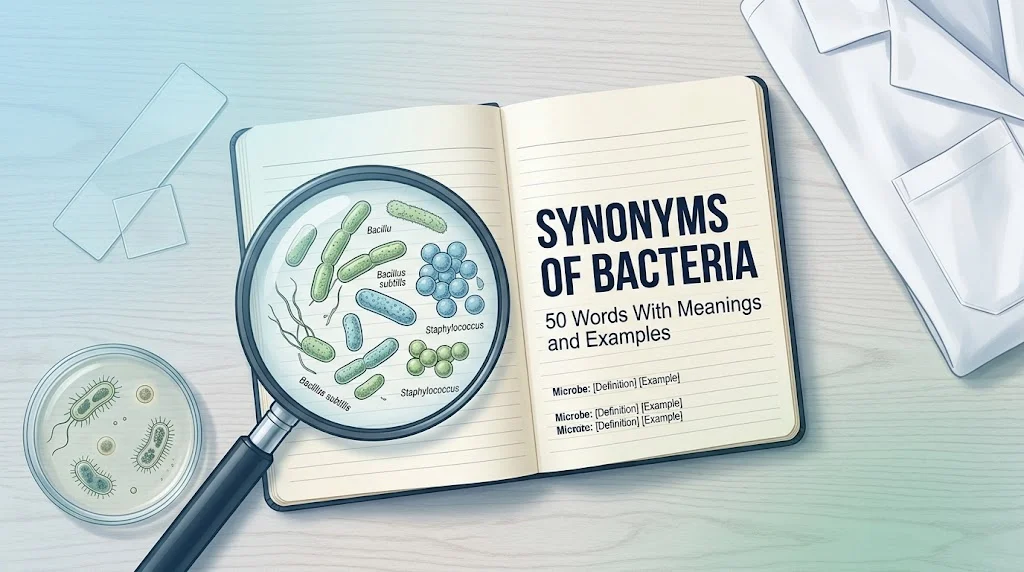
Bacteria are microscopic single-celled organisms found almost everywhere. Common related terms include microbes, germs, microorganisms, pathogens, and prokaryotes. Choose based on whether you mean scientific classification, disease, or everyday language.
A science student may search for synonyms of bacteria while writing a lab report about microorganisms in pond water. A health writer may need a simpler word when explaining how germs spread in a crowded classroom. The right term depends on whether the context is scientific, medical, or everyday.
This guide to synonyms of bacteria presents 50 related terms with clear meanings and natural examples. You will see how microbe, germ, pathogen, prokaryote, and microbiome differ in scope, formality, and accuracy. The goal is to help you choose the word that fits your exact idea.
50 Synonyms and Related Words for Bacteria
1. Microbe
Short Meaning: A microscopic living thing, especially one that can cause disease or fermentation.
Example 1: The scientist studied each microbe found in the soil sample.
Example 2: Not every microbe is harmful; many help digest our food.
2. Microorganism
Short Meaning: Any living thing too small to be seen without a microscope.
Example 1: The pond water was full of tiny microorganisms swimming under the lens.
Example 2: Microorganisms in the soil break down dead leaves and plants.
3. Germ
Short Meaning: An everyday word for a microorganism that can cause disease.
Example 1: Washing your hands removes germs that can make you sick.
Example 2: The child learned that germs spread when people cough.
4. Pathogen
Short Meaning: A microorganism that causes disease in a host organism.
Example 1: The lab identified the pathogen responsible for the outbreak.
Example 2: Vaccines train the body to fight specific pathogens.
5. Prokaryote
Short Meaning: A single-celled organism without a nucleus, including bacteria and archaea.
Example 1: Bacteria are prokaryotes because they lack a true nucleus.
Example 2: Students compared prokaryotes and eukaryotes under the microscope.
6. Bacterium
Short Meaning: The singular form of bacteria, one single-celled organism.
Example 1: A single bacterium can multiply into millions within hours.
Example 2: The bacterium was resistant to several common antibiotics.
7. Bacillus
Short Meaning: A rod-shaped bacterium, often forming spores in harsh conditions.
Example 1: The bacillus survived the heat by forming a protective spore.
Example 2: Scientists studied the bacillus to understand its growth cycle.
8. Coccus
Short Meaning: A round or spherical shaped bacterium.
Example 1: The coccus bacteria appeared as tiny circles under the microscope.
Example 2: Some coccus species cause infections in the throat.
9. Spirillum
Short Meaning: A spiral shaped bacterium with a rigid, corkscrew form.
Example 1: The spirillum moved through the liquid with a twisting motion.
Example 2: Spirillum bacteria can be found in stagnant water.
10. Vibrio
Short Meaning: A comma shaped bacterium, often found in water.
Example 1: The vibrio bacteria caused illness after people ate raw seafood.
Example 2: Scientists studied vibrio in coastal waters during the summer.
11. Spirochete
Short Meaning: A long, spiral shaped bacterium that moves in a corkscrew manner.
Example 1: The spirochete causes Lyme disease and is spread by ticks.
Example 2: Spirochetes are thin and difficult to see with a light microscope.
12. Rickettsia
Short Meaning: A type of bacteria that lives inside cells and spreads through ticks or fleas.
Example 1: Rickettsia causes spotted fever and requires prompt treatment.
Example 2: The researcher studied rickettsia in infected insects.
13. Chlamydia
Short Meaning: A group of bacteria that live inside host cells and cause infections.
Example 1: Chlamydia is a common bacterial infection that can be treated.
Example 2: The lab tested for chlamydia using a urine sample.
14. Mycoplasma
Short Meaning: A very small bacterium that lacks a cell wall.
Example 1: Mycoplasma can cause pneumonia and other respiratory infections.
Example 2: Because it lacks a cell wall, mycoplasma resists certain antibiotics.
15. Cyanobacteria
Short Meaning: Photosynthetic bacteria that can form blooms in water.
Example 1: Cyanobacteria produce oxygen and were among Earth’s first life forms.
Example 2: The lake turned green after a bloom of cyanobacteria.
16. Archaea
Short Meaning: A separate domain of single-celled organisms, often living in extreme places.
Example 1: Archaea look like bacteria but differ in their cell structure.
Example 2: Some archaea live in hot springs and survive extreme heat.
17. Flora
Short Meaning: The collection of microorganisms living in or on a particular area.
Example 1: The gut flora helps break down food and fight harmful bacteria.
Example 2: Antibiotics can disrupt the natural flora of the body.
18. Microbiome
Short Meaning: The complete community of microorganisms living in a specific environment.
Example 1: The human gut microbiome contains trillions of helpful bacteria.
Example 2: Scientists study the soil microbiome to improve crop health.
19. Microbiota
Short Meaning: The microorganisms themselves that live in a particular place.
Example 1: The skin microbiota protects against harmful invaders.
Example 2: Changes in diet can affect the gut microbiota within days.
20. Culture
Short Meaning: A laboratory growth of microorganisms for study or testing.
Example 1: The doctor sent a culture to identify the bacteria causing the infection.
Example 2: The culture grew rapidly in the warm laboratory incubator.
21. Colony
Short Meaning: A visible group of microorganisms grown from a single cell.
Example 1: Each colony on the plate came from one original bacterium.
Example 2: The researcher counted every colony to estimate the population.
22. Strain
Short Meaning: A specific genetic variant within a species of bacteria.
Example 1: The new strain was resistant to most available antibiotics.
Example 2: Scientists compared the strain with samples from other regions.
23. Species
Short Meaning: A group of closely related organisms that can interbreed.
Example 1: The species of bacteria was identified by its genetic code.
Example 2: Each species has adapted to a particular environment.
24. Genus
Short Meaning: A scientific category that groups closely related species.
Example 1: The genus includes several species of harmful bacteria.
Example 2: Scientists renamed the genus after new genetic evidence.
25. Family
Short Meaning: A broader scientific category that groups related genera.
Example 1: The family includes many common soil and water bacteria.
Example 2: Researchers compared members of the same bacterial family.
26. Domain
Short Meaning: The highest scientific category of life, such as Bacteria or Archaea.
Example 1: Bacteria form one of the three domains of life on Earth.
Example 2: The domain Bacteria includes thousands of known species.
27. Kingdom
Short Meaning: A traditional scientific category, now less used for bacteria.
Example 1: Early scientists placed bacteria in the kingdom Monera.
Example 2: The kingdom classification has changed with new research.
28. Monera
Short Meaning: An old scientific kingdom that included all bacteria and similar organisms.
Example 1: The kingdom Monera is no longer used in modern biology.
Example 2: Older textbooks still refer to Monera when discussing bacteria.
29. Eubacteria
Short Meaning: A term once used for true bacteria, as opposed to archaea.
Example 1: Eubacteria include most of the bacteria we encounter daily.
Example 2: The term eubacteria has largely been replaced by Bacteria.
30. Archaebacteria
Short Meaning: An old term for archaea, once thought to be a type of bacteria.
Example 1: Archaebacteria live in extreme environments like hot springs.
Example 2: Scientists now classify archaebacteria as a separate domain.
31. Gram-positive
Short Meaning: Bacteria that retain a purple stain in the Gram test.
Example 1: Gram-positive bacteria have a thick cell wall that holds the stain.
Example 2: The doctor prescribed an antibiotic effective against gram-positive bacteria.
32. Gram-negative
Short Meaning: Bacteria that do not retain the purple stain and appear pink.
Example 1: Gram-negative bacteria have a thinner cell wall and an outer membrane.
Example 2: Many gram-negative bacteria are resistant to common antibiotics.
33. Aerobic
Short Meaning: Bacteria that need oxygen to grow and survive.
Example 1: Aerobic bacteria thrive in the oxygen-rich surface layers of soil.
Example 2: The aerobic culture grew well in the ventilated container.
34. Anaerobic
Short Meaning: Bacteria that grow without oxygen and may be harmed by it.
Example 1: Anaerobic bacteria live deep in the soil where oxygen is scarce.
Example 2: The infection was caused by anaerobic bacteria in the wound.
35. Facultative
Short Meaning: Bacteria that can grow with or without oxygen.
Example 1: Facultative bacteria adapt easily to changing oxygen levels.
Example 2: The facultative strain survived both in air and in sealed jars.
36. Autotroph
Short Meaning: An organism that makes its own food from simple substances.
Example 1: Some bacteria are autotrophs that use sunlight to make energy.
Example 2: Autotrophic bacteria form the base of many deep-sea food webs.
37. Heterotroph
Short Meaning: An organism that gets its food from other organic matter.
Example 1: Most bacteria are heterotrophs that feed on dead plants.
Example 2: The heterotroph needed organic material to grow in the lab.
38. Saprophyte
Short Meaning: An organism that feeds on dead or decaying organic matter.
Example 1: Saprophyte bacteria break down fallen leaves in the forest.
Example 2: The saprophyte played a key role in recycling nutrients.
39. Parasite
Short Meaning: An organism that lives on or in another and harms it.
Example 1: The parasite caused a serious infection in the patient.
Example 2: Some bacteria are parasites that damage their hosts.
40. Commensal
Short Meaning: An organism that lives with another without harming or helping it.
Example 1: Many commensal bacteria live on human skin without causing disease.
Example 2: The commensal relationship benefits one side without hurting the other.
41. Symbiont
Short Meaning: An organism that lives in close partnership with another.
Example 1: The symbiont provides nutrients that the host cannot make.
Example 2: Some bacteria are symbionts that help plants absorb nitrogen.
42. Antibiotic
Short Meaning: A medicine that kills bacteria or stops their growth.
Example 1: The doctor prescribed an antibiotic for the bacterial infection.
Example 2: Overuse of antibiotics can lead to resistant bacteria.
43. Antimicrobial
Short Meaning: A substance that kills or inhibits microorganisms, including bacteria.
Example 1: The antimicrobial soap reduced the number of germs on the hands.
Example 2: Researchers tested the antimicrobial effect of the new coating.
44. Disinfectant
Short Meaning: A chemical used on surfaces to destroy harmful microorganisms.
Example 1: The cleaner sprayed disinfectant on every table and door handle.
Example 2: Disinfectant kills bacteria but may not remove all viruses.
45. Sterilization
Short Meaning: The process of removing or killing all microorganisms from an object.
Example 1: Sterilization of the surgical tools prevents dangerous infections.
Example 2: The lab uses heat sterilization for glass equipment.
46. Infection
Short Meaning: The invasion of the body by harmful microorganisms.
Example 1: The wound became red and swollen because of an infection.
Example 2: Bacterial infection can be treated with the right medicine.
47. Contamination
Short Meaning: The presence of unwanted microorganisms in a substance or place.
Example 1: The water was tested for contamination after the flood.
Example 2: Contamination of the food led to a public health warning.
48. Outbreak
Short Meaning: A sudden rise in cases of a disease in a specific area.
Example 1: The outbreak was traced to a single source of contaminated water.
Example 2: Health officials acted quickly to contain the outbreak.
49. Epidemic
Short Meaning: A widespread outbreak of a disease in a region or population.
Example 1: The cholera epidemic spread quickly through the crowded city.
Example 2: Vaccination programs helped end the epidemic within two years.
50. Pandemic
Short Meaning: An epidemic that spreads across multiple countries or the whole world.
Example 1: The pandemic changed how people worked and traveled.
Example 2: Scientists worked together to track the pandemic and its variants.
Short Quiz
1: What are bacteria most commonly?
A. Large animals
B. Microscopic single-celled organisms
C. Types of plants
D. Minerals found in rocks
2: Which word best completes the sentence? Washing your hands removes ______ that can make you sick.
A. germs
B. minerals
C. vitamins
D. proteins
3: What is the main difference between a bacterium and a virus?
A. A bacterium is a living cell, while a virus is not a cell and needs a host to reproduce.
B. A bacterium is always larger than a virus and can be seen with the naked eye.
C. They mean exactly the same thing.
D. A virus is a type of bacterium.
4: Which word is most suitable for a formal scientific essay about disease?
A. Germ
B. Bug
C. Pathogen
D. Critter
5: Which term describes bacteria that can grow with or without oxygen?
A. Facultative
B. Aerobic
C. Anaerobic
D. Autotroph
Quiz Answers
B. Bacteria are microscopic single-celled organisms.
A. Germs is the everyday word for microorganisms that cause disease.
A. A bacterium is a living cell, while a virus is not a cell and needs a host.
C. Pathogen is formal and suitable for a scientific essay about disease.
A. Facultative bacteria can grow with or without oxygen.
FAQs
What is the simplest synonym for bacteria in everyday English?
Germ is the simplest everyday word, though it usually refers only to harmful bacteria.
Which term should I use in a formal scientific essay instead of bacteria?
Microorganism or prokaryote often suit formal scientific writing, depending on the exact meaning.
What is the difference between bacteria and viruses?
Bacteria are living single-celled organisms, while viruses are much smaller and cannot reproduce without a host cell.
Can bacteria be helpful rather than harmful?
Yes, many bacteria are helpful and live in the human gut, soil, and oceans.
Are synonyms of bacteria always interchangeable?
No, terms related to bacteria vary in scientific accuracy and context, so choose based on your meaning.
Conclusion
Alternative vocabulary helps writers communicate more precisely and avoid unnecessary repetition. A single word can change the tone of a sentence, so the best choice depends on meaning, context, tone, audience, and purpose.
Some words suit scientific writing, while others fit health articles, school essays, or casual conversation. Before choosing, ask what you want to emphasize: scientific classification, disease, or everyday language. The right word should make your idea clearer, not just sound more advanced.
Use this guide as a practical resource when you need synonyms of bacteria. Pick the word that communicates your intended idea most clearly, then read the sentence aloud to check whether it sounds natural and accurate.
Read More Related Articles :
- 300+ Synonyms Of Desperate | Powerful, Emotional & Expressive Words In 2026
- 300+ Synonyms Of Kindness | Heartwarming, Caring & Compassionate Words In 2026
- 300+ Synonyms Of Harsh | Powerful, Strong & Descriptive Words In 2026
