Quick Answer
Ambivalent describes having mixed or conflicting feelings about something or someone. Common alternatives include conflicted, torn, of two minds, undecided, and hesitant. Choose based on tone and context.
A graduate may feel ambivalent about accepting a job offer far from home, and a reader may feel ambivalent about a novel that is both beautiful and slow. When the same word keeps appearing, writers search for synonyms of ambivalent to keep their language precise and varied.
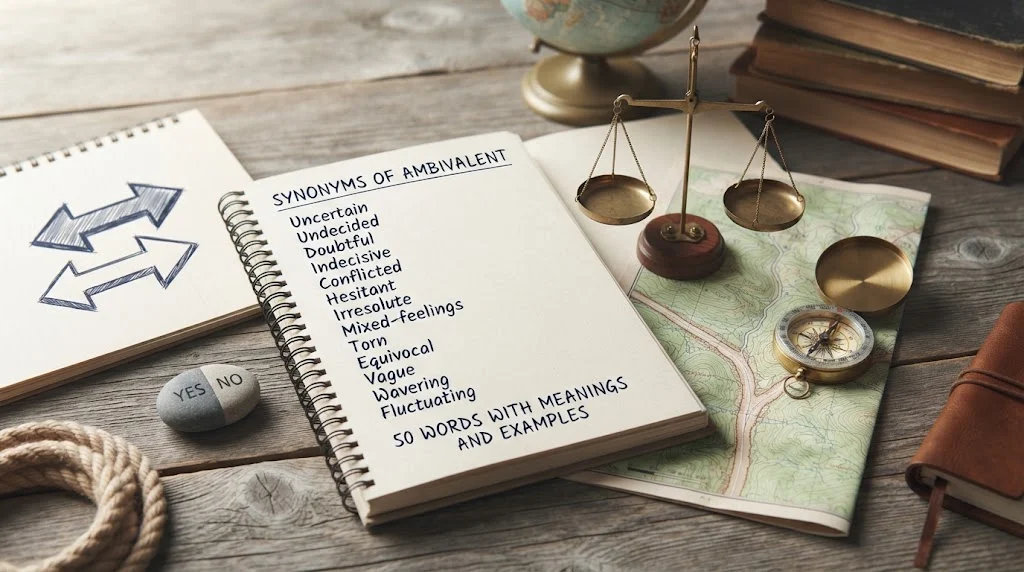
This guide to synonyms of ambivalent presents 50 alternatives with clear meanings and natural examples. You will see how conflicted, torn, hesitant, equivocal, and double-edged differ in tone, strength, and formality. The goal is to help you choose the word that fits your exact idea.
50 Synonyms and Related Words for Ambivalent
1. Mixed feelings
Short Meaning: A state of having both positive and negative emotions about something at once.
Example 1: She had mixed feelings about moving away from her childhood home.
Example 2: He felt mixed feelings when his old team won without him.
2. Conflicted
Short Meaning: Feeling pulled in different directions by opposing emotions or loyalties.
Example 1: She felt conflicted about accepting the job so far from family.
Example 2: He was conflicted between honesty and protecting his friend.
3. Torn
Short Meaning: Deeply divided between two choices, often causing emotional pain.
Example 1: She was torn between studying medicine and pursuing art.
Example 2: He felt torn when both friends asked for his support.
4. Of two minds
Short Meaning: Unable to decide because you see good reasons on both sides.
Example 1: I am of two minds about whether to move abroad.
Example 2: She was of two minds regarding the new company policy.
5. Undecided
Short Meaning: Not having made a final choice or reached a firm conclusion.
Example 1: The voters remained undecided until the final debate.
Example 2: He was undecided about which university to attend.
6. Uncertain
Short Meaning: Not sure or confident about something, often because of incomplete information.
Example 1: She felt uncertain about the outcome of the interview.
Example 2: The team was uncertain whether the project would continue.
7. Unsure
Short Meaning: Lacking confidence or certainty about a choice or situation.
Example 1: He was unsure how his parents would react to the news.
Example 2: She felt unsure about signing the contract that day.
8. Hesitant
Short Meaning: Slow to act or speak because of doubt or reluctance.
Example 1: He was hesitant to share his opinion during the meeting.
Example 2: She felt hesitant about lending him her car.
9. Wavering
Short Meaning: Changing back and forth between decisions or opinions over time.
Example 1: His wavering support made the team nervous about the plan.
Example 2: She kept wavering between two very different career paths.
10. Vacillating
Short Meaning: Repeatedly changing between different choices or feelings.
Example 1: The committee spent weeks vacillating over the budget.
Example 2: He kept vacillating about whether to sell the house.
11. Irresolute
Short Meaning: Lacking determination or firmness in making decisions.
Example 1: Her irresolute manner frustrated the rest of the group.
Example 2: He seemed irresolute when asked about his future plans.
12. Indecisive
Short Meaning: Often unable to make choices quickly or firmly.
Example 1: He is so indecisive that ordering food takes an hour.
Example 2: The manager’s indecisive leadership slowed the whole project.
13. Doubtful
Short Meaning: Feeling unsure or skeptical about whether something is true or possible.
Example 1: She was doubtful that the plan would work in practice.
Example 2: He felt doubtful about the team’s chances of winning.
14. Skeptical
Short Meaning: Not easily convinced, often questioning claims or proposals.
Example 1: The investors were skeptical about the startup’s rapid growth claims.
Example 2: She remained skeptical of the sudden change in policy.
15. Reluctant
Short Meaning: Unwilling or hesitant to do something, often because of doubt or fear.
Example 1: He was reluctant to leave his stable job for a new venture.
Example 2: She felt reluctant about attending the family reunion.
16. Half-hearted
Short Meaning: Done with little enthusiasm, effort, or genuine commitment.
Example 1: His half-hearted apology did not satisfy the injured party.
Example 2: She gave a half-hearted smile and looked away.
17. Lukewarm
Short Meaning: Showing little enthusiasm or warmth, often neither positive nor negative.
Example 1: The audience gave the speech a lukewarm response.
Example 2: Her lukewarm reaction to the gift surprised everyone.
18. Reserved
Short Meaning: Slow to show feelings or opinions, often keeping emotions private.
Example 1: He stayed reserved during the discussion and said little.
Example 2: She seemed reserved about the whole idea of moving.
19. Noncommittal
Short Meaning: Deliberately avoiding a clear opinion or firm decision.
Example 1: The official gave a noncommittal answer to every question.
Example 2: Her noncommittal tone made it hard to read her feelings.
20. Equivocal
Short Meaning: Open to more than one interpretation, often intentionally unclear or ambiguous.
Example 1: The report’s equivocal language confused most readers.
Example 2: He gave an equivocal reply that satisfied no one.
21. Ambiguous
Short Meaning: Having more than one possible meaning, often leaving people unsure.
Example 1: Her ambiguous comment left the team guessing her true view.
Example 2: The contract used ambiguous terms that caused later disputes.
22. Contradictory
Short Meaning: Containing ideas or feelings that conflict with each other.
Example 1: His contradictory statements made the police doubt his story.
Example 2: She felt contradictory emotions about seeing him again.
23. Conflicting
Short Meaning: Different or opposing, often describing feelings, reports, or interests.
Example 1: She had conflicting feelings about the job offer.
Example 2: The two reports gave conflicting accounts of the accident.
24. Paradoxical
Short Meaning: Seeming to contradict itself yet possibly true in some way.
Example 1: It is paradoxical that he loves company but avoids parties.
Example 2: Her paradoxical attitude puzzled everyone who knew her.
25. Dual
Short Meaning: Having two parts or aspects that exist together.
Example 1: He felt a dual loyalty to both his family and his country.
Example 2: The role has a dual purpose, teaching and research.
26. Twofold
Short Meaning: Having two distinct parts, aspects, or possible meanings.
Example 1: Her reaction was twofold, relief and deep sadness.
Example 2: The problem is twofold, involving both money and time.
27. Divided
Short Meaning: Separated into opposing groups, opinions, or feelings.
Example 1: The community was divided over the new development plan.
Example 2: His heart was divided between two very different paths.
28. Split
Short Meaning: Divided between two choices, groups, or strong feelings.
Example 1: The committee was split on whether to approve the budget.
Example 2: She felt split between loyalty and honesty.
29. On the fence
Short Meaning: Not yet decided, often waiting to see how things develop.
Example 1: Many voters are still on the fence about the election.
Example 2: He remained on the fence about joining the new project.
30. Tentative
Short Meaning: Not certain or final, done with hesitation or caution.
Example 1: They reached a tentative agreement that still needed approval.
Example 2: She gave a tentative smile and waited for his reply.
31. Provisional
Short Meaning: Arranged or agreed for the present but likely to change.
Example 1: The provisional schedule may change after the holidays.
Example 2: They made a provisional plan to meet next month.
32. Qualified
Short Meaning: Limited or modified by conditions, not complete or absolute.
Example 1: Her support was qualified, depending on the final details.
Example 2: He gave qualified approval to the proposal.
33. Guarded
Short Meaning: Careful not to reveal true feelings or opinions openly.
Example 1: His guarded answers made the interview difficult to read.
Example 2: She remained guarded about her plans for the future.
34. Detached
Short Meaning: Emotionally distant or not involved in a situation.
Example 1: He seemed detached from the argument happening around him.
Example 2: Her detached tone made the news feel less personal.
35. Neutral
Short Meaning: Not supporting either side, often showing no strong feeling.
Example 1: The mediator stayed neutral throughout the entire discussion.
Example 2: His neutral expression revealed nothing about his opinion.
36. Unresolved
Short Meaning: Not yet settled or decided, often causing ongoing uncertainty.
Example 1: The question of who would lead remained unresolved.
Example 2: Her unresolved feelings about the past kept her awake.
37. Unsettled
Short Meaning: Uncertain, restless, or not yet decided or resolved.
Example 1: He felt unsettled about the sudden change in plans.
Example 2: The matter remained unsettled after hours of debate.
38. Oscillating
Short Meaning: Moving back and forth between two positions or feelings.
Example 1: Her mood kept oscillating between hope and despair.
Example 2: The committee spent months oscillating between two options.
39. Fluctuating
Short Meaning: Changing frequently between different levels or states.
Example 1: His enthusiasm for the project kept fluctuating week by week.
Example 2: Her confidence was fluctuating during the difficult training.
40. Shifting
Short Meaning: Changing position, opinion, or feeling over time.
Example 1: His shifting loyalties made him hard to trust.
Example 2: The debate showed her shifting views on the issue.
41. Weighing
Short Meaning: Carefully considering different options or sides before deciding.
Example 1: She spent the evening weighing the pros and cons.
Example 2: He was weighing whether to accept the offer.
42. Deliberating
Short Meaning: Thinking carefully and often slowly about a decision.
Example 1: The jury spent two days deliberating the final verdict.
Example 2: She was still deliberating when the deadline arrived.
43. Second-guessing
Short Meaning: Doubting a decision you already made or are about to make.
Example 1: He kept second-guessing his choice to leave the company.
Example 2: Her constant second-guessing made the process exhausting.
44. In limbo
Short Meaning: In an uncertain state, waiting for a decision or outcome.
Example 1: The project stayed in limbo while the budget was reviewed.
Example 2: After graduation, he felt in limbo about his next step.
45. Caught between
Short Meaning: Trapped between two options, people, or strong feelings.
Example 1: She felt caught between her parents’ wishes and her own dreams.
Example 2: He was caught between loyalty to his friend and the truth.
46. Straddling
Short Meaning: Trying to support or belong to two different sides at once.
Example 1: The senator was straddling two very different voter groups.
Example 2: She felt like she was straddling two cultures at home.
47. Wobbling
Short Meaning: Going back and forth, unable to stay firm on a decision.
Example 1: His support kept wobbling as new facts appeared.
Example 2: The committee was wobbling on the final vote.
48. Two-sided
Short Meaning: Having two distinct parts, often opposing or balancing each other.
Example 1: The debate had a two-sided argument worth considering.
Example 2: Her feelings were two-sided, love and deep frustration.
49. Double-edged
Short Meaning: Having both a positive and a negative aspect at the same time.
Example 1: Fame is a double-edged gift that brings joy and pressure.
Example 2: The offer was double-edged, with benefits and hidden risks.
50. Inner conflict
Short Meaning: A struggle between opposing feelings or desires within a person.
Example 1: His inner conflict showed clearly on his tired face.
Example 2: She struggled with inner conflict before making the choice.
Short Quiz
1: What does ambivalent most commonly mean?
A. Feeling completely certain
B. Having mixed or conflicting feelings about something
C. Feeling extremely angry
D. Showing no emotion at all
2: Which word best completes the sentence? She felt ______ between studying medicine and pursuing art.
A. torn
B. neutral
C. detached
D. lukewarm
3: What is the main difference between ambivalent and neutral?
A. Ambivalent means having opposing feelings, while neutral means having no strong feeling either way.
B. Ambivalent means angry, while neutral means happy.
C. They mean exactly the same thing.
D. Neutral is only used in science.
4: Which word is most suitable for a formal academic essay about mixed feelings?
A. Wobbling
B. On the fence
C. Equivocal
D. In limbo
5: Which word would best describe a gift that brings both benefits and risks?
A. Double-edged
B. Detached
C. Neutral
D. Reserved
Quiz Answers
B. Ambivalent means having mixed or conflicting feelings about something.
A. Torn fits the sentence about two competing choices.
A. Ambivalent involves opposing feelings, while neutral means no strong feeling.
C. Equivocal is formal and suitable for academic writing about mixed feelings.
A. Double-edged describes something with both positive and negative aspects.
FAQs
Which synonym of ambivalent sounds most natural in everyday English?
Conflicted, torn, and of two minds usually sound most natural in everyday English.
Which word should I use in a formal essay instead of ambivalent?
Equivocal, paradoxical, or contradictory often suit formal academic and professional writing.
What is the difference between ambivalent and indecisive?
Ambivalent means having mixed feelings, while indecisive means being unable to make a choice.
Can ambivalent describe a person as well as a feeling?
Yes, ambivalent can describe a person’s attitude, and it can also describe a decision, response, or relationship.
Are synonyms of ambivalent always interchangeable?
No, synonyms of ambivalent vary in formality, tone, and strength, so context should guide your choice.
Conclusion
Alternative vocabulary helps writers communicate more precisely and avoid unnecessary repetition. A single word can change the tone of a sentence, so the best choice depends on meaning, context, tone, audience, and purpose.
Some words suit formal essays, while others fit workplace notes, stories, or casual conversation. Before choosing, ask what you want to emphasize: inner conflict, simple hesitation, or a balanced view of two sides. The right word should make your idea clearer, not just sound more advanced.
Use this guide as a practical resource when you need synonyms of ambivalent. Pick the word that communicates your intended idea most clearly, then read the sentence aloud to check whether it sounds natural and accurate.
Read More Related Articles :
- 150+ Synonyms Of Reflective | Thoughtful, Contemplative & Insightful Words to Elevate Your Writing In 2026
- 150+ Synonyms Of Impending | Powerful Words for Something About to Happen Soon In 2026
- 350+ Synonyms Of Alliance | Powerful, Professional & Strategic Alternatives With Meanings In 2026
